You're going to have to forgive me for being away Monday, when the non-conference schedule was released. After all, Hofstra only released it TWO-AND-A-HALF MONTHS EARLIER than it did last year. I guess when you're playing Kansas and UConn, as opposed to a bunch of schools that may or may not have begun playing basketball before Y2K, you want everyone to know about it ASAP.
Anyway, please stop back later today or, more likely, tomorrow for a more in-depth look at and take on a suddently buff OOC as well as ample apologies for my sporadic posting lately. Thanks.
Tuesday, June 30, 2009

Monday, June 1, 2009
Follow the yellow (and blue) brick road!
 Oh yeah. One hundred and seventy-one days until the Flying Dutchmen wipe the smile off the beak!
So imagine Mom and Dad come to you on July 8 and tell you that they’ve heard there’s going to be a brand spanking new video game system that is like Nintendo plus Sega plus Atari, except 150 times better, and that as long as it comes out before Christmas they’re going to get it for you. You’d be looking at the calendar and wondering what to do with yourself for the next 171 days, wouldn’t you?
I mean, once you’ve gotten a glimpse of the future, it’s kind of tough to go back to that Intellivision, with its clunky controllers (I’ve got a great idea! Put the most important buttons ON THE SIDES!!) and even clunkier overlays. All the cool kids had Atari. Nobody ever wanted to hear about the awesome graphics on the Intellivision or how Mattel had the rights to NFL Football or Major League Baseball. Nobody ever come over to play Pac-Man knockoff Lock ‘N Chase or Space Invaders knockoff Space Armada. They wanted to play the so-called real things on Atari, despite graphics that looked like they were designed by an eight-year-old with absolutely no artistic skill.

Seriously, we used to have to play this crap.
Where was I? Oh yeah. We’re approximately 171 days away from the Flying Dutchmen almost surely opening the 2009-10 season at the University of Kansas. You know…Kansas. Rock Chalk Jayhawk. Likely 2009-10 preseason no. 1. 2008 national champions. Danny Manning and the Miracles. Alma mater of the dude who invented basketball.
Sure, there’s a couple qualifiers in the above graph, but athletic director Jack Hayes appeared on WRHU’s The Locker Room last night and said an agreement to play the game “…is pretty close.
“I think if you went to a lot of basketball fans and said what are the five places you’d want to see a game, Allen Fieldhouse is going to be on most people’s list,” Hayes said. “[Kansas] certainly has an unbelievable tradition of success coming off a national championship a couple years ago. This will be a test for us, but these are the kind of tests and the kind of situations that we want to put our team in.”
I know you liked opening the season against the likes of Clemson, Holy Cross, Charlotte and Florida International, but, well, they’re kinda like tube socks and slacks and polo shirts, aren’t they? Necessities, sure, but nobody ever hustles downstairs Christmas morning to rip the wrapping paper off those gifts.
But Kansas? Kansas? I’m not saying I’m bouncing off the walls in anticipation of Christmas Day—err, Nov. 15, at least if Kansas opens its season on the third Sunday of November like it did last year—but I just looked at Expedia and a round-trip flight to Kansas City from one of the New York-area airports is a little over $500. That’s a small price to pay to watch the Flying Dutchmen knock off the top-ranked team in the country! Then we’ll be no. 1! That’s how these things work, right? Unless Tom O’Connor has a vote, of course.
And really, why should Hofstra be intimidated by Kansas? So “Rock Chalk Jayhawk” rolls off the tongue and Allen Fieldhouse is one of the most legendary venues in the country. I’d rather be unique like Hofstra, which has no chants because most fans refuse to refer to the team by its “official” nickname and plays in a 10-year-old arena best known for looking exactly like the one at Delaware.
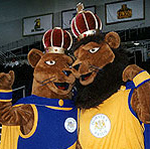
The Jayhawk ain’t all that tough. Kate and Willie could probably kick his butt.
Kansas might begin the season no. 1? Pffft. Hofstra’s probably going to be picked to finish in the top four in the CAA. You know what that means, right? A 25 percent chance of winning the post-season tournament!
Sure, the Jayhawks won it all in 2008, but there’s no Supernintendo Chalmers to save them now! And Hofstra hits its free throws! And the Flying Dutchmen won’t miss a buzzer-beater in a postseason elimination game! Wait a minute…
Danny Manning and the Miracles can’t hold a candle to Darius Burton and the…umm…err…Three Wins In Three Daysers! And without Butch van Breda Kolff, James Naismith’s invention never takes flight!!
That’s right. Bring it on, Jayhawks.
Of course, I’m just talking out of my backside, much more so than usual. I fully realize Hofstra’s best chance of winning that game probably involves the Kansas starting five being kidnapped and replaced by The Jayhawks, the Minneapolis-based alt-country band who hit it moderately big with “Waiting on the Sun” the year the Flying Dutchmen played an independent schedule (oh yeah, you didn’t see that coming, did you?). The real Jayhawks may be so good and so unstoppable next year that I’ll be curled into the fetal position somewhere in Allen Fieldhouse, sucking my thumb and begging for mercy (or, more likely, kicking a barstool at my local Applebees).
But it’ll be fun getting there. My best friend lives in Lawrence (and, ironically in that it’s not ironic at all, he grew up a Syracuse fan, which meant he was also the target of my barbs the last time Hofstra played a top 10 team) and another good friend is a Kansas grad, so we can all go at it until the two teams finally tip off.
And short of everyone on the roster deciding it likes Kansas so much it would rather play for Division II Pittsburg State than return home, the trip to Lawrence is a no-lose proposition for Hofstra. The school makes a crapload of money for heading to Kansas. The Flying Dutchmen get the experience of playing a top-tier team and do so with a group of players well-equipped for such an opponent and the possibilities that come with it. Keep the game close—or, dear God, win it outright—and it would provide an immeasurable boost for the 2009-10 team as well as the entire program.
If they lose by 35? It’s probably not going to destroy the Dutchmen’s confidence. Could we have said the same thing the previous two years?
“I’m just not sure if coming off 12-18 and losing your all-time leading scorer was the best time to go and play the defending national champions,” Hayes told WRHU. “But in this case, we have a talented group coming back and I think it’ll be a good test for us.”
The big test for the rest of us will be tempering our enthusiasm between now and the day the Flying Dutchmen channel their inner Chaminade. That happened at a Christmas tournament, by the way. The so-called real Christmas, not the one that is now only 171 days away. Are we there yet? I’m tired of my Intellivision.
Email Jerry at defiantlydutch@yahoo.com. And join the Defiantly Dutch group at Facebook today!
Friday, May 22, 2009
Hey SBU lax…don’t come around here no more (and maybe you too, football and hoops)
 Will Hofstra be singing "I Won't Back Down" when it comes to ending the men's lacrosse rivalry with Stony Brook?
Hope you didn’t get too excited about my grand proposal for the new ECC featuring Hofstra and Stony Brook. Newsday reported on its website Thursday that Hofstra has chosen to end the men's lacrosse series with Stony Brook.
This of course does not mean the two schools can never compete in the same conference, or even that their men’s lacrosse teams can never again play one another in a regular season game. But it’s worth wondering if this is the first volley in a brewing Cold War between the school and a sign that Hofstra will soon decide there aren’t enough benefits to playing Stony Brook in the three major sports.
Flying Dutchmen coach Seth Tierney says pulling out of the series with Stony Brook is a matter of the Dutchmen wanting to play Manhattan and St. John’s. And adding those two schools to the schedule and subtracting Stony Brook should upgrade Hofstra’s strength of schedule. Like Stony Brook, Manhattan has made the NCAA Tournament once. St. John’s, meanwhile, begins play next season in the Big East, which should be one of the top conferences in the land with 10-time national champion Syracuse as well as perennial tournament team Notre Dame among its seven schools.
Nor, with Jack Hayes not available to comment for Marcus’ story, do we know the whole story from the Hofstra side (Stony Brook coach Rick Sowell and athletic director Jim Fiore are both quoted in the story and it’s mentioned that the 2007 game at Stony Brook raised money for Lacrosse for Autism, so those who think Marcus favors Stony Brook because he went there are going to have a field day with this one).
But I can’t imagine games against the Jaspers or Red Storm will generate any excitement among people who follow lacrosse a lot more than me (line forms to the left). Hofstra has never played Manhattan and is 9-2 against St. John’s, but the schools have played just once since St. John’s resumed playing lacrosse in 2005 after a nine-year absence. The Flying Dutchmen smoked the Red Storm, 19-3, in ’05.
And if the annual lacrosse game between the schools is vulnerable, is football next? Hofstra has never lost to Stony Brook in football, but this is the first year since the two teams were both in Division III that they’re on equal footing scholarship-wise. What was already a no-win proposition for Hofstra is particularly so now, especially with Stony Brook placing a bigger emphasis on football than Hofstra. Who wants to suffer the indignity of 12-0 turning into something-and-1?
I think the annual men’s basketball game between the two schools is safe: Stony Brook has plenty to gain in playing it and Tom Pecora is a proponent of playing as many local schools as possible. But who’s to say the decision will be Pecora’s—especially if Sowell is right in presuming that it was a “group decision” to end the series by Hofstra, one in which “…part of that group had a lot more to say than the other parts of the group.”
If Hofstra is hitching its wagon to the men’s basketball team—and it is—and it really does view the A-10 as its long-term home and is prepared to wait a long time to join the conference, might the school want to prepare for the move by disassociating itself from lower mid-majors such as Stony Brook?
And if that happens…I wonder if Fiore, who has much bigger things in mind than the America East and the Big South, takes it personally and goes all-in to try and outdo Hofstra. The two schools trying to outrace each other to the top of the mid-major world—or even beyond—would add a delicious wrinkle to the rivalry.
Alas, it would also remind us how difficult it could be to mend fences if the big boys refuse to let either Hofstra or Stony Brook sit at their tables and they are forced to settle for something else. Because while we may think Hofstra and Stony Brook are a perfect conference fit, the news Thursday is a pretty good indicator at least one of the schools doesn’t agree.
Email Jerry at defiantlydutch@yahoo.com. And join the Defiantly Dutch group at Facebook today!
Monday, May 18, 2009
Bits and Bytes: The Conference Shuffle
 Drexel in the Big 5! I'm such an idiot!
The headline to the article by Dick “best toupee in sports journalism” Weiss in the Sunday Daily News doesn’t leave much room for interpretation: “New conference home is what Hofstra needs to take hoops program to the next level.” Like the rest of us, Weiss doesn’t know exactly how this will happen, only that it should.
My favorite part of the article was the ancient photo of Pecora the News used. No, not one of him from Adelphi, but one in which Aurimas Kieza is in the background. I really would have been impressed if they managed to find one of Pecora with, say, Chris McRae in the background. Oh yeah. Bet you didn’t think you’d read that name today did you?
The most interesting part, meanwhile, was Pecora saying he worries the CBI and CIT will give the NCAA—which now owns the NIT—the excuse to turn the NIT into the JV tournament for the Big Six and relegate the mid-majors to the pay-to-plays.
That makes a lot of sense, and I appreciate Pecora still toeing the company line about why Hofstra didn’t accept a bid to either tourney. But still: Pecora still thought the CBI and CIT were good ideas for a team such as his in February. And if these fledgling tournaments that may admittedly be to college basketball what the Garden State Bowl was to college football were good enough for Old Dominion, then they should have been good enough for Hofstra.
Enough about that. A couple other bits and bytes about the conference shuffle we pondered last week:
—Thanks to Gonzo Hofstra Fan, a Loyal Reader who correctly points out that Drexel is not a member of the Big 5. Penn is, along with Villanova, Temple, St. Joseph’s and LaSalle. However, in my defense, Wikipedia—which is never wrong—states that Drexel has become something of an unofficial honorary (is that redundant?) member of the Big 5 and that it is part of the City 6, a term I’d never before heard. I hope Drexel does join the Big 5 and that the schools are still referred to as the Big 5. That would be very A-10ish.
—Isolated rumble or the beginning of the nationwide seismic conference changes? Campbell is leaving the Atlantic Sun for the Big South. Hmmm.
—The Patriot League going the full scholarship route in football in order to get back a school that never should have left sounds good in theory, but a closer read of Lehigh Football Nation’s excellent and in-depth post about the financial difficulties several Patriot League schools are experiencing makes me less certain that Fordham will be able to return. Schools that are pleading poverty can’t very easily add scholarships to football programs that are probably losing money already. An obvious compromise would be to accept Fordham back into the Patriot in everything but football, but does that solve anything for a school that looks as if it’s ready to make football its marquee sport? Might it be better in the long run for Fordham to find an all-sports home rather than going independent in football or trying to find a conference where it is not a geographic fit, a la Stony Brook in the Big South?
Email Jerry at defiantlydutch@yahoo.com. And join the Defiantly Dutch group at Facebook today!
Thursday, May 14, 2009
Nobody asked me, but…here’s how Hofstra could be part of a brand-new ECC
 Take Hofstra, Northeastern and Drexel from the CAA, Providence, Seton Hall and St. John's from the Big East and mix them up with LaSalle and Stony Brook and...HIVENGLAVIN!!!!
This was a false alarm. Please return to your homes and continue pricing flights to Richmond for next year’s CAA Tournament as well as sending nasty Twitter messages to Jim Larranaga (seriously, Litos must really think a lot of my self-restraint to post that bit of info, and doubly seriously, don’t send nasty Twitter messages to anyone, even someone at George Mason).
All that talk about Hofstra leaving the CAA for the A-10 was apparently premature, as Steve Marcus reported Wednesday. But I wouldn’t be in a rush to buy a wardrobe full of clothes sporting the CAA logo, either.
One of these times, the buzz about changing leagues will be legitimate. And it won’t just be Hofstra and a handful of CAA schools doing the conference shuffle. The current Division I landscape is an overfilled backyard pool, busting at the seams and liable to explode and flood the neighborhood at any moment.
The expansion of Division I to 353 schools means 31 conferences are no longer enough. A 16-team Big East…a 14-team Atlantic 10…13 other conferences with more than 10 schools, including our beloved CAA. And no matter how much CBS and your average bracket-filling Joe might love it, the 65-team NCAA Tournament has outlived its usefulness.
It’s time to blow the whole damn thing up.
It won’t be easy, of course. Bigger is better for the BCS conferences. After all, the Big East can’t try to get nine bids to the NCAA Tournament if it only has eight schools.
And the NCAA has made it as difficult as possible for anyone to think outside the box (groan) and form conferences that are more geographically and numerically friendly. Under current NCAA guidelines, the Great West Conference, the first new conference this decade, won’t be eligible for an automatic bid to the men’s tournament until 2020, by which point we’ll all be getting around in flying cars.
The NCAA did what it does best—bent the rules as it saw fit—the last time a new conference was formed in 1999, when the Mountain West broke off from the WAC. Mountain West schools had to wait only two years to receive an automatic bid to the NCAA Tournament.
Something tells me the NCAA won’t be as eager to award an automatic bid to the Great West and rob another deserving 17-12 BCS school of an at-large bid. But what if the Great West is just one of three new conferences? And what if waiving the usual requirements and awarding automatic bids to these new conferences after two years—and expanding the NCAA Tournament to 68 teams—means March Madness creeps into the national conscience a couple days earlier than it does now?
A 68-team tournament would allow for four play-in games that would take place, two apiece, on Tuesday and Wednesday. That makes for six consecutive glorious days of hoops during the first week of the tournament. Hard to argue with that, yes?
Sure, a North Dakota State might be ticked off because it was not eligible for the NCAA Tournament until its fifth year at Division I. Just because that’s the way it used to be doesn’t mean it should always be that way. I had to type my research papers in college on a Brother word processor, but I don’t plan on subjecting my kid(s) to that if I ever procreate.
Most importantly, from the perspective of a Hofstra fan, what if one of these new conferences features the Flying Dutch as a core member? It’d be the first time since the ECC that Hofstra would be on legitimately equal footing in its conference (the school was on its way to that kind of stature in the America East before the departure for the CAA).
What if the new conference was the old conference? What do you think about this East Coast Conference that features multiple natural rivalries and saves the member schools countless thousands of dollars in travel expenses?
Hofstra
Northeastern
Drexel
Seton Hall
St. John’s
Providence
Stony Brook
LaSalle
I have to think that any realignment of Division I will be centered around breaking up the Big East. And if and when that happens, the non-BCS schools that are mired in the middle and back of the conference—DePaul, Providence, St. John’s and Seton Hall—will be the ones most endangered.
All four schools have glorious hoops histories that overshadow anything Hofstra, Northeastern, Drexel, Stony Brook and LaSalle have accomplished, and I can’t imagine Providence, St. John’s and Seton Hall want anything to do with joining a bunch of eastern mid-majors. But they may not have a choice.
The Big East Three are afterthoughts in their own conference now. Georgetown and Villanova, in particular, have proven it’s possible to reverse such a downfall. But all you’ve got to do to accomplish that is hire the son of the most legendary coach in school history (actually, DePaul already did that) and a guy from Hofstra, respectively. Maybe Providence can get Rick Pitino Jr., but Seton Hall and St. John’s aren’t getting their paws on Tom Pecora.
LaSalle is the choice for the second Philly-area school because St. Joseph’s and Temple are far more established in the A-10. Stony Brook hasn’t even been a Division I school for 10 years yet, but the school has much bigger things in mind than the America East. Better to just cut ties now and take some growing pains in the new ECC.
I imagine any new conference will have more than eight teams, but such a small alignment leaves room for other schools to make the leap as well as takes into account future expansion. And the new ECC could be really interesting if the football-playing Big East schools end up overtaking the league and pushing out the non-football schools.
Can you imagine a 10-team ECC that also features Georgetown and Villanova? Lehigh Football Nation wonders if the recent departure of Georgetown AD Bernard Muir for the same position at Delaware is the precursor to Georgetown getting the boot from the Big East (and, somewhere down the line, Delaware joining the Big East).
To ditch Georgetown, Villanova and Marquette—all of whom are national championship-winning programs that have reached the Final Four this decade—would require a ruthlessness and short-sightedness that is hard to comprehend. Which of course means you can’t rule it out.
My third new conference, by the way, has been dubbed the Great South and features a bunch of Division I newcomers as well as a familiar face:
Longwood
Savannah State
NC-Central
Kennesaw
SC-Upstate
Lipscomb
NC-Wilmington
The more I think about it and talk to people who know more about it than me (line forms to the left), the more I think Wilmington would be in some serious danger if the CAA wants to be known for football as much as basketball. That said, this Great South was concocted in about five minutes and with the knowledge the Atlantic Sun probably wouldn’t be thrilled if Kennesaw, South Carolina-Upstate and Lipscomb bolted.
Plus, I’m sure college hoops fans south and west of the White House can come up with a new conference or two formed from the wreckage of the bloated likes of the Sun Belt, Southern, Southland and Conference USA, though breaking up the latter would be difficult since all 12 of its schools play I-A football.
Lastly, here’s what the new CAA, Big East and A-10 would look like:
CAA:
Charlotte
Delaware
George Mason
Georgia State
James Madison
Old Dominion
Richmond
Towson
VCU
William & Mary
Like Georgetown, Villanova and Marquette in the Big East, VCU and Mason are established enough in basketball (and in the board room) to survive despite not playing football.
Big East:
Cincinnati
Connecticut
Georgetown
Louisville
Marquette
Notre Dame
Pittsburgh
Rutgers
South Florida
Syracuse
Villanova
West Virginia
A-10:
Dayton
DePaul
Duquesne
George Washington
Massachusetts
Rhode Island
St. Bonaventure
Saint Louis
St. Joseph’s
Temple
Xavier
I realize this runs counter to what I wrote yesterday, when I said Saint Louis made no sense for the A-10, but add DePaul and suddenly you can split the league into two divisions—the East (GW, UMass, URI, St. Bonaventure, St. Joes and Temple) and the West (Dayton, DePaul, Duquesne, Saint Louis and Xavier). Can the A-10 lure a Horizon or Missouri Valley school to even out the divisions?
Fun stuff to chew on, for sure, even if it’s just talk for now. But at some point this will be a lot more than talk, because it’s hard to imagine anyone being satisfied with the status quo—at Hofstra and far beyond. And for Hofstra, at least, the best solution is a fresh start in a newly formed conference…one with an old name, of course.
Email Jerry at defiantlydutch@yahoo.com. And join the Defiantly Dutch group at Facebook today!
Wednesday, May 13, 2009
Nobody asked me, but…here’s how Hofstra could end up in the A-10
 Hopefully, the reconfigured A-10 will have a more mathematically accurate name. (This won out over a picture of Jillian Barberie, sorry fellas)
Just because I’m writing about how Hofstra could end up in the Atlantic 10 doesn’t mean I believe it can or should happen. I haven’t changed my mind since three months ago yesterday, when I wrote that a move to the A-10 would by no means provide the Flying Dutchmen basketball team an easier path to the NCAA Tournament nor fuller houses at the Arena. That Litos agrees with me means I might actually be on to something for one of the few times in the last nine months.
But assuming a move to the A-10 is what the administration wants, here’s how it could work. Merely adding Hofstra to the A-10—and making it the A-15—won’t work. A 14-team conference is already as bloated as the before picture in a NutriSystem ad. My plan does reduce the A-10 to 13 teams, not quite a Jillian Barberie-esque loss, but better than the way it was. (This is what happens when you write in the middle of the night...NutriSystem references)
Here’s what would have to happen:
1.) Richmond and Charlotte to the CAA. Longtime CAA fans still haven’t forgiven Richmond for bolting the CAA for the A-10 in 2001, a move which set off the whole poaching of the A-East by the CAA. But those at the administrative level are more practical about these things, and I imagine both the CAA and Richmond would admit they never should have divorced in the first place. Litos reports Richmond’s A-10 games have all the excitement of a church service, but a return to the CAA would instantly make the Spiders the biggest rival of every other Virginia school in the CAA. Plus, Richmond’s national champion football team already plays in the CAA. This is a fine fit. Make it happen.
Charlotte, meanwhile, is already selling personal seat licenses in anticipation of its first season of football in 2013. That’s right: The school is selling you the chance to buy tickets to a program that is at least four years from debuting. God Bless America.
Charlotte administrators hope to follow the path of South Florida and make I-AA a quick pit-stop on the way to I-A (and, one presumes, the Big East). Such big plans might make the CAA reluctant to welcome Charlotte, especially since it’d probably mean having to add yet another football-playing school by the middle of next decade, but hey, Hofstra wants to leave after eight years, so having to reconfigure on the fly is nothing new.
2.) Fordham to the Patriot League. As mentioned Monday, the move to the A-10 has been an unqualified disaster for the Fordham men’s basketball team. The Rams lack the facilities to compete in the A-10 and their academic standards remain at a Patriot League level. This, too, is a reunion that makes sense for both sides. The one hurdle might be Fordham’s desire to add football scholarships: The blog Lehigh Football Nation does a great job of explaining why the rest of the Patriot League may not be ready to sink that kind of dough into its football programs any time soon. But at the least, Fordham to the Patriot League in every other sport makes all sorts of sense.
3.) Saint Louis to the Horizon League. What, exactly, is Saint Louis doing in the Atlantic-10, anyway? I guess you could say the same thing about Ohio schools Xavier and Dayton, but at least Ohio has a semblance of a connection to the east coast. Not so much Missouri.
Switching conferences is nothing new for Saint Louis, which has played in six leagues in the last 35 years. One of those was the precursor to the Horizon League. Saint Louis back to the Horizon League is so perfect that I have to figure the school considers itself too good for the Horizon. But the Billikens’ men’s basketball team has as many NCAA Tournament berths in the last 50 years as Hofstra: Four. In addition, Saint Louis’ men’s soccer program has won a record 10 national titles, but none since 1973. You guys are not above the Horizon League. Go there.
4.) Hofstra, Northeastern and Drexel to the A-10. Talk about burying the lede. The A-10 is a good match for the CAA Three on multiple levels. The A-10 is the best existing home for Hofstra and Northeastern if they deemphasize or drop football. With no football team, Drexel no longer fits with a southern-based conference that wants to be known as much for its football as its basketball. And the three schools leaving together provide each other some traditional rivals in the new conference.
In addition, each school has some nice natural rivalries with the current A-10 membership. Hofstra and St. Joseph’s have played a couple great NIT games in the last five years. Drexel’s inclusion gives the A-10 four of the Big 5 Philly schools. And Northeastern provides the A-10 three New England schools.
As important as the fit for men’s basketball is the fit in every other sport. The A-10 sponsors 14 of Hofstra’s 18 sports. We’ve already placed the football team in the new ECC, and presumably, the CAA would welcome Hofstra as an associate member in men’s lacrosse and wrestling (where it is the league’s highest-profile program in both sports) as well as women’s golf.
The A-10 sponsors 15 of Northeastern’s 19 sports, and both of the Huskies’ crew and hockey teams already compete outside of the CAA. (The A-10 sponsors women’s crew, but not men’s crew) And the A-10 sponsors 14 of Drexel’s 16 sports, with the only exceptions being men’s lacrosse (where Drexel could join Hofstra as an associate member of the CAA) and men’s crew.
Here’s how the new A-10 would look:
Dayton
Drexel
Duquesne
George Washington
Hofstra
LaSalle
Massachusetts
Northeastern
Rhode Island
St. Bonaventure
St. Joseph’s
Temple
Xavier
An odd number of teams isn’t as unusual as I thought: Nine Division I conferences have an odd number. So unless someone powerful within the A-10 has triskaidekaphobia, this could work.
Nor would scheduling be nearly as difficult as I thought. With 12 opponents, an 18-game schedule in which each team has six opponents it plays twice a season and six opponents it plays once a season is quite doable.
The six teams Hofstra would play twice would be Drexel, LaSalle, UMass, Northeastern, St. Joseph’s and Temple. For fun’s sake, I decided Northeastern would play Drexel, Duquesne (gotta cater to the fans who loathe Ron Everhart for bolting for the Dukes), Hofstra, UMass, Rhode Island and St. Bonaventure twice each. And Drexel would play Hofstra, George Washington, LaSalle, Northeastern, St. Joseph’s and Temple twice apiece.
Damn. Reservations about how it’ll help the men’s basketball programs aside, this actually sounds possible. So that means it won’t happen. And I still think my third idea—detonating the Division I landscape and creating four new conferences, one of which will feature Hofstra as a core founding member—is the best idea. Tune in later today or first thing tomorrow for that.
Email Jerry at defiantlydutch@yahoo.com. And join the Defiantly Dutch group at Facebook today!
Monday, May 11, 2009
Nobody asked me, but…here’s how Hofstra can leave the CAA & keep the football program
 We'll definitely need to update this logo.
The last conference Hofstra left behind didn’t benefit a bit from the departure. It didn’t do the America East any good for Hofstra to leave and take Delaware, Drexel and Towson along for the ride following the 2000-01 school year. Those four teams combined to win nine of the preceding 10 men’s basketball championships.
(Actually, those titles were won entirely by Hofstra, Delaware and Drexel, which means Towson was the me of the America East at the turn of the century. During my perpetually single gawky teenage years, you could technically say “Randy, Scott, Kyle and Jerry have combined for 10 girlfriends,” even though you could drop me from the equation and those three would still have had 10 girlfriends. I don’t want to talk about it. Where was I?)
In 2001, the America East ranked 20th out of 31 conferences in Ken Pomeroy’s rankings. Since then, the A-East has matched or improved upon that performance just twice (16th in 2005 and 20th in 2007). The CAA, meanwhile, ranked 13th in Pomeroy’s rankings in 2001. It has ranked 13th or better five times since and has finished below 14th just once.
But the CAA shouldn’t miss a beat if Hofstra is serious about leaving. As competitive as the Flying Dutchmen have been the last five years, they still haven’t ended the dominance of southern teams in the men’s basketball tournament. And the conference is established enough as a premier mid-major to know it can replace Hofstra with a school of a similar or better profile.
Yet it’s football, not basketball, that makes this a mutually beneficial departure. A departure by Hofstra and another school (more on its identity in a moment) begins to solve the logistical nightmare looming when Old Dominion and Georgia State join the football league in 2011 and 2012, respectively. A 12-team conference is big enough. A 14-team conference is just about untenable (of course, if Hofstra ends up in the 14-team Atlantic 10, I reserve the right to spin baby spin about how 14 teams is in fact tenable).
In addition, the immediate success of the CAA in football—the league received a record five bids to the I-AA tournament in 2007 and matched the feat last year, when James Madison was the top-ranked team in the country most of the regular season before Richmond won the national championship—makes it and basketball interchangeable atop the pecking order. So it behooves the schools who play football to be as invested on the gridiron as on the basketball court
That, in turn, provides an opportunity for a graceful exit from the CAA and scholarship football for Hofstra (a possibility I pondered in November, never expecting it would theoretically present itself a few months later) as well as Northeastern, the latter of which has substandard football facilities and nearly terminated the program last year. The school announced it would redouble its efforts to bolster all its athletic programs, but such a plan is vague enough so that football scholarships can be pulled for the greater good.
Also, Northeastern should accompany Hofstra in any conference switch in order to provide it a natural rival, since the success of CAA football makes it very unlikely Delaware will follow the Dutch out the door.
Get Rhode Island—which has had three winning seasons in the last 20 years and hasn’t reached the I-AA playoffs since 1985, the second-longest drought among CAA schools behind only Towson—to leave the CAA as well and you’ve got the core of a new non-scholarship football conference. We can go old school and dub it the Yankee Conference, or go old school with a bit of originality by calling it the East Coast Conference.
We’ll go with East Coast Conference. Here’s how it would look:
Hofstra
Northeastern
Rhode Island
Georgetown
Marist
Dayton
Albany
The non-CAA schools are listed in the likelihood that they’d be interested in joining the hypothetical ECC. Georgetown plays football in the Patriot League, which offers need-based financial aid to gridders. But Fordham is reportedly demanding the conference add football scholarships, and Hofstra’s possible move to the A-10, coupled with Fordham’s complete lack of success in the A-10 since its ill-conceived leap to the conference in 1995, means maybe the Patriot League acquiesces on football scholarships in order to get Fordham back into the fold in all sports.
Marist, which is one of only two former MAAC football schools still playing the sport (too bad Iona dropped football after last year; it would be perfect here), is an obvious good fit in the ECC, but the big hurdle to its inclusion is its commitment to the Pioneer League, a non-scholarship league in which the Red Foxes will begin play this fall. However, the ECC would be a lot easier on the travel budget than the Pioneer League, whose other schools are located in South Carolina, Florida, Ohio, Indiana, Iowa, Kentucky and California.
Dayton is also in the Pioneer League, but Hofstra joining the A-10 would create a clear fit for both schools in ECC football. The biggest problem with Dayton is its location: The Flyers would have to—wait for it!!—fly to just about every destination in the conference, whereas the other six schools are all located within doable driving distance of one another.
We all learned after Albany beat Hofstra last year that the Great Danes did it with one scholarship. But Albany is listed last among the potential ECC candidates because it is enjoying success in the Northeast Conference, where it has won the last two championships, and because the NEC announced last year it will allow schools to offer as many as 40 scholarships by 2013, up from the current maximum of 30.
Among the schools that almost surely wouldn’t fit in the ECC: Duquesne (an A-10 school that plays football, but it upgraded from non-scholarship when it joined the Northeast Conference last year), Stony Brook (will be at 63 scholarships this year), Campbell and Davidson (Pioneer schools located too far south), Bryant (a former Division II power transitioning to I-AA that presumably does not want to spend all that time and money to play at the non-scholarship level) and NEC schools Central Connecticut, Robert Morris, Sacred Heart, Monmouth, Wagner and St. Francis (PA) (all six are NEC members in all sports).
So seven teams it is for the ECC. Scheduling isn’t as easy with only six conference games, but figure Hofstra could continue its rivalries with Delaware and Stony Brook, add another local foe in Division II C.W. Post and play a couple games a year against NEC teams. That’s 11 games.
Of course, there’s absolutely no guarantee Hofstra wants to risk playing Post, or that it will want to play Stony Brook when the Seawolves (0-11 all-time against the Flying Dutchmen) are fully loaded and playing in the CAA (you read that right), or that Delaware will want anything to do with Hofstra once it drops scholarships. But that’s why this is hypothetical.
Oh, and even though we won’t care about the CAA if Hofstra leaves it, here’s how the CAA would look under my plan:
CAA NORTH
Delaware
Maine
Massachusetts
New Hampshire
Stony Brook (the best fit for a full-scholarship SBU)
Villanova
CAA SOUTH
Georgia State
James Madison
Old Dominion
Richmond
Towson
William & Mary
As for the proposed ECC, it’s probably the best way to satisfy almost everyone. The tradition of Hofstra football remains alive and doesn’t alienate alums of both the playing and non-playing variety.
Any hopes of contending for a national championship are probably out the window in returning to non-scholarship ball. But Joe Gardi built a Top 20 team without scholarships in 1994, and a year later, the Dutchmen opened 10-0 and nearly beat Marshall in the regular season finale even though the only scholarship players were freshmen. So who says it can’t be done again? Plus, with the I-AA tournament expanding to 20 teams in 2010, there may eventually be an automatic bid to be won in the ECC.
As for the administration, going non-scholarship lessens the bottom line beating the school has been taking with football and also assures all the money invested on football facilities over the last 15 years doesn’t go to waste. And the new conference is much less of a travel headache.
I’d like to think compromise is a legitimate possibility, that nobody at Hofstra dislikes the football team enough to end the program. Though it did happen at Boston University, albeit after more than a quarter-century of effort by president John Silber.
A resolution, one way or the other, is a long ways off, if there even needs to be anything resolved. In the meantime, stop back tomorrow, when I’ll examine how a move to the A-10 could work for Hofstra and the men’s basketball program in particular.
Email Jerry at defiantlydutch@yahoo.com. And join the Defiantly Dutch group at Facebook today!
Subscribe to:
Posts (Atom)